
What Is Considered a Fever? Thresholds, Causes & When to Worry
Fever is one of the most common reasons people reach for a thermometer — and one of the most misunderstood. Many people treat any temperature above “normal” as an emergency, while others ignore genuinely high readings. The truth is that fever is usually a sign your immune system is working, not a disease in itself.
This guide explains exactly what temperature counts as a fever in adults and children, how to measure it accurately, what causes fever, how doctors investigate it, how to manage it safely at home, and the warning signs that mean you should seek medical care.
Medically reviewed by Dr. Ata Ullah, MD (Medicine), Physician Consultant.
What Is Considered a Fever?
A fever is generally defined as a body temperature of 100.4°F (38°C) or higher. This is the threshold used by medical organisations worldwide, including guidance for deciding when a child or adult needs medical evaluation (NHS guidance on fever in adults).
Normal body temperature is often quoted as 98.6°F (37°C), but this is an average — healthy temperatures vary from person to person and throughout the day. Most people’s temperature runs lower in the morning and higher in the late afternoon and evening, and it can rise slightly after exercise, hot weather, or a warm bath. A reading of 99.5°F (37.5°C) after activity, for example, is not necessarily a fever.
Fever thresholds at a glance
- Normal: about 97–99°F (36.1–37.2°C)
- Low-grade fever: 100.4–102°F (38–38.9°C)
- Moderate to high fever: 102–104°F (38.9–40°C)
- High fever needing prompt attention: above 104°F (40°C)
- Medical emergency: above 106°F (41.1°C) — risk of organ damage
Fever temperature chart: °F and °C
| Reading | °F | °C | What it means |
|---|---|---|---|
| Normal range | 97–99°F | 36.1–37.2°C | Not a fever |
| Elevated | 99–100.3°F | 37.2–38°C | Not technically a fever — monitor |
| Low-grade fever | 100.4–102°F | 38–38.9°C | Fever — rest and fluids |
| Moderate fever | 102–104°F | 38.9–40°C | Consider fever reducers; watch symptoms |
| High fever | Above 104°F | Above 40°C | Seek prompt medical advice |
Quick answers: is it a fever?
| Your reading | Fever? | What to do |
|---|---|---|
| 98.6°F (37°C) | No | Average normal temperature |
| 99.1°F (37.3°C) | No | Slightly elevated — not a fever |
| 99.5°F (37.5°C) | Usually not | Within normal daily variation |
| 100.4°F (38°C) | Yes | Official fever threshold — rest, fluids |
| 101°F (38.3°C) | Yes | Low-grade fever |
| 102°F (38.9°C) | Yes | Moderate fever — consider fever reducers |
| 103°F (39.4°C) | Yes | High fever — get medical advice |
| 104°F+ (40°C+) | Yes | High fever — seek prompt medical care |
Note for infants under 3 months: any reading of 100.4°F (38°C) or higher needs same-day medical evaluation.
Sources: NHS — Fever in adults; Mayo Clinic — Fever. The 100.4°F (38°C) threshold is the widely used clinical definition of fever.
The number is not the whole story. How a person feels and behaves often matters more than the exact reading. A child with a 102°F fever who is playful and drinking fluids is usually less concerning than a lethargic child with a 100.5°F fever.
Causes & Risk Factors
Fever is not an illness — it is the body’s deliberate response to one. When the immune system detects infection or inflammation, it releases substances that reset the brain’s thermostat (the hypothalamus) to a higher temperature, creating conditions less favourable for many germs.
Common causes of fever
- Viral infections: colds, flu, COVID-19, gastroenteritis — the most common cause by far
- Bacterial infections: strep throat, urinary tract infections, pneumonia, ear infections
- Inflammatory conditions: rheumatoid arthritis and other autoimmune diseases
- Heat-related illness: heat exhaustion and heatstroke (note: in heatstroke the body’s cooling system fails — this is an emergency)
- Medicines: some drugs, including certain antibiotics and seizure medicines, can cause drug fever
- Vaccinations: mild, short-lived fever after immunisation is a normal immune response
- Teething (infants): may cause a mild temperature bump, but it does not cause a true fever of 100.4°F or higher on its own
Symptoms That Accompany Fever
Fever itself produces recognisable sensations:
- Feeling hot, then chilled — shivering as temperature rises
- Sweating as the fever breaks
- Headache and muscle aches
- Fatigue and weakness
- Loss of appetite
- Dehydration — dry mouth, reduced urination
- Irritability (in children)
- Rapid heartbeat and faster breathing
Tests & Diagnosis: Finding the Cause
Because fever is a symptom, diagnosis means finding its source:
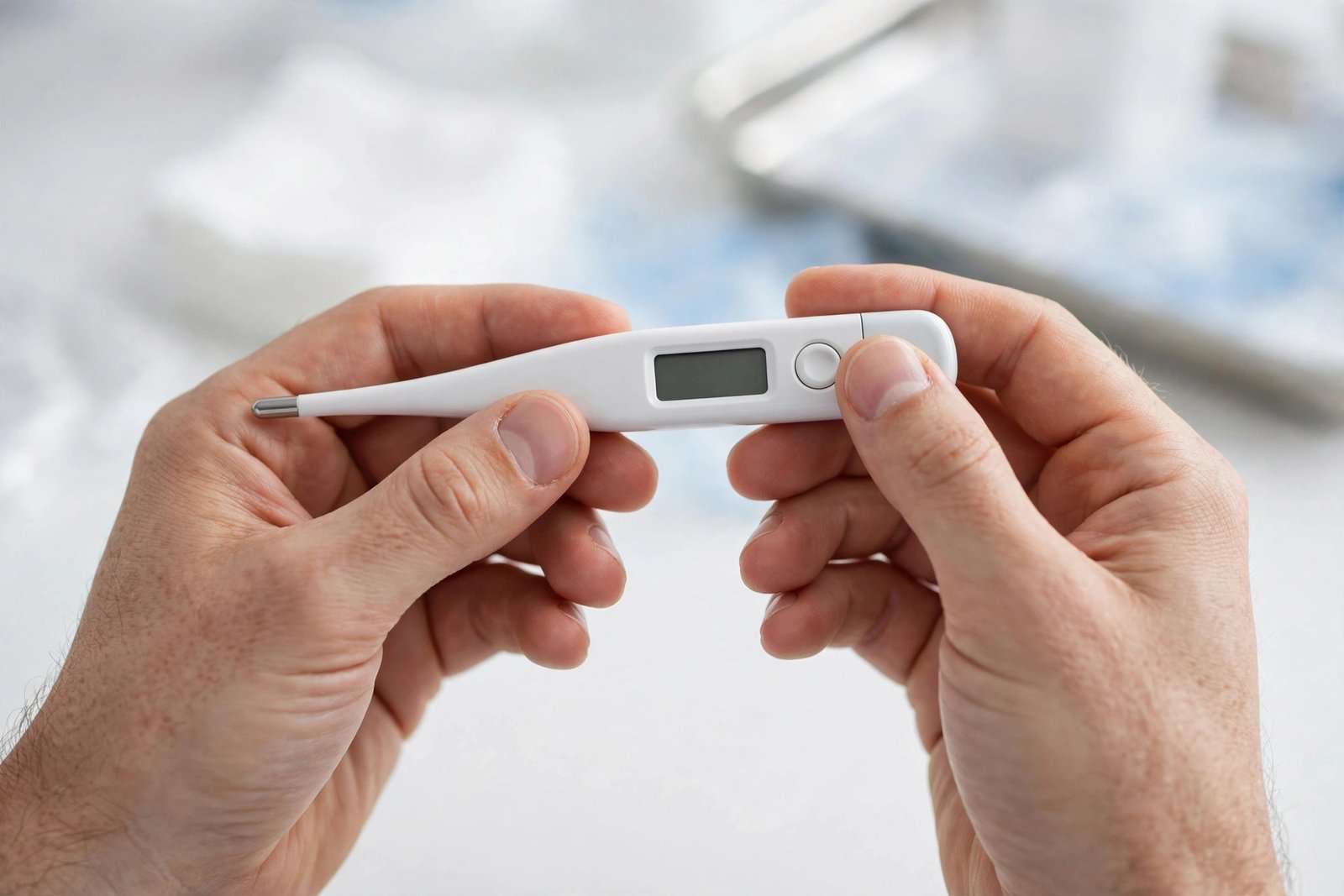
- Accurate temperature measurement: Rectal thermometers give the most accurate reading in infants; oral digital thermometers are standard for older children and adults (wait 15–30 minutes after hot or cold drinks); ear (tympanic) and forehead (temporal artery) thermometers are convenient but slightly less precise; armpit readings run about a degree lower. Rectal readings run about a degree higher than oral ones, so the same body can produce different numbers at different sites; forehead and ear readings are quick for screening, though technique and earwax can affect ear readings.
- Medical history and physical examination: The doctor asks about accompanying symptoms, recent travel, sick contacts, and medicines, and examines the ears, throat, lungs, and skin.
- Blood tests: A complete blood count (CBC) can suggest bacterial versus viral infection; blood cultures may be drawn if bloodstream infection is suspected.
- Urinalysis and urine culture: To check for urinary tract infection, a common fever source.
- Chest X-ray: If cough or breathing symptoms suggest pneumonia.
- Rapid tests: For flu, COVID-19, or strep throat when symptoms point that way.
Treatment Options
Treating the cause
The most important treatment targets whatever is causing the fever — antibiotics for bacterial infections, antivirals for influenza in high-risk patients, and specific treatment for other underlying conditions. A fever that persists despite treatment of the obvious cause deserves re-evaluation.
Managing the fever itself
- Fever-reducing medicines (antipyretics): Paracetamol (acetaminophen) or ibuprofen lower temperature and ease aches and headache. They are given for comfort — not every fever needs to be lowered.
- Fluids: Drink plenty of water, broth, or oral rehydration solutions to replace fluid lost through sweating.
- Rest: The body fights infection best when it is not spending energy elsewhere.
- Light clothing and a cool room help the body release heat; avoid bundling up in heavy blankets.
- Do not try to “sweat out” a fever — bundling up in heavy blankets or exercising through a fever raises body temperature further and increases fluid loss.
- Lukewarm sponge baths can provide comfort, but avoid cold water or alcohol rubs, which can cause shivering and drive temperature up.
Never give aspirin to children or teenagers with a fever. Giving aspirin to children or teenagers who are fighting a viral infection carries a small risk of Reye’s syndrome — an uncommon but dangerous disorder that can injure the brain and liver. Use age-appropriate paracetamol or ibuprofen instead, dosed by weight according to the package or your doctor.
Should you always bring a fever down? Not necessarily. Mild to moderate fever helps the immune system fight infection, and routinely suppressing it has not been shown to shorten illness. Treat the person’s comfort — if they are resting comfortably, it is often fine to let a low-grade fever run its course while monitoring.

Lifestyle Management & Prevention
- Prevent infections: Handwashing, staying up to date on vaccinations (flu, COVID-19, pneumococcal), and avoiding close contact with sick people reduce fever-causing illnesses.
- Stay hydrated during any illness, even before fever appears.
- Keep a thermometer at home and know how to use it correctly for each family member’s age.
- Track the pattern: Note the highest readings, how long the fever lasts, and accompanying symptoms — this information helps your doctor enormously.
- Rest and nutrition: Adequate sleep and a balanced diet keep the immune system ready to respond.
When to See a Doctor
Seek urgent medical care if:
- Any infant under 3 months has a rectal temperature of 100.4°F (38°C) or higher — this always needs prompt evaluation
- Fever above 104°F (40°C) in anyone
- Fever lasting more than 3 days
- Severe headache, stiff neck, or sensitivity to light
- Difficulty breathing or chest pain
- Persistent vomiting or inability to keep fluids down
- Confusion, extreme drowsiness, or difficulty waking
- Seizure (febrile seizures in young children need evaluation after the event)
- Rash, especially one that does not fade when pressed
- Signs of dehydration: very dry mouth, no tears, little or no urination
- Fever after recent travel, animal bite, or tick bite
Key Takeaways
- A fever is defined as a body temperature of 100.4°F (38°C) or higher.
- Fever is usually a helpful immune response, not a disease — the underlying cause is what needs diagnosis and treatment.
- Measure accurately: rectal is most reliable in infants; oral digital thermometers suit older children and adults.
- Treat comfort with fluids, rest, and age-appropriate fever reducers; not every fever must be brought down.
- Any fever in an infant under 3 months, fever above 104°F, or fever lasting more than 3 days warrants medical attention.
Frequently Asked Questions
Is 99.5°F a fever?
Generally no — it falls within normal daily variation. Fever is defined as 100.4°F (38°C) or higher.
Should I alternate paracetamol and ibuprofen?
Alternating is sometimes suggested but can lead to dosing errors. Stick to one medicine, dosed correctly, unless your doctor advises otherwise.
Can teething cause a fever?
Teething can bring mild fussiness and a slight rise in temperature, but a reading of 100.4°F or higher is a true fever and needs another explanation — look for another cause.
Is exactly 100.4°F (38°C) a fever?
Yes — 100.4°F (38°C) is the clinical threshold where a raised temperature is officially defined as a fever, per NHS and Mayo Clinic guidance.
Is 99.1°F a fever?
No — 99.1°F (37.3°C) is slightly elevated but below the 100.4°F (38°C) fever threshold. It falls within normal daily variation; rest, monitor, and recheck later.
What is considered a high fever in adults?
Above 103°F (39.4°C) is generally considered a high fever in adults, and anything above 104°F (40°C) warrants prompt medical advice.
Reviewed by Dr. Ata Ullah
Dr. Ata Ullah — MBBS, MD Medicine, Physician Consultant. Dr. Ata Ullah is a Senior Medical Officer with extensive experience in internal medicine, dedicated to helping patients understand their health through clear, evidence-based guidance.
“Your Health, Our Responsibility.”
Medical Disclaimer: This article is for informational purposes only and is not a substitute for professional medical advice, diagnosis, or treatment. Always seek the advice of your physician or another qualified health provider with any questions you may have regarding a medical condition. Never disregard professional medical advice or delay seeking it because of something you have read on this site.
Online Consultation: Dr. Ata Ullah (MBBS, MD Medicine), Physician Consultant / Medical Specialist — WhatsApp: 0315 7148181 — Consultation Fees: $30