
PCOS Symptoms, Causes and Treatment
Medically reviewed by Dr. Ata Ullah, MD (Medicine), Physician Consultant.
PCOS — polycystic ovary syndrome — ranks among the most frequently diagnosed endocrine conditions affecting women in their reproductive years, yet it remains one of the most misunderstood. It can show up as irregular periods, stubborn acne, unwanted facial hair, weight that refuses to budge, or difficulty conceiving. Because its signs vary so widely, many women spend years being told their symptoms are “just stress” before anyone names the condition. This guide explains what PCOS is, what drives it, the symptoms to recognise, how doctors diagnose it, and the treatments and lifestyle steps that genuinely help.

What Is PCOS?
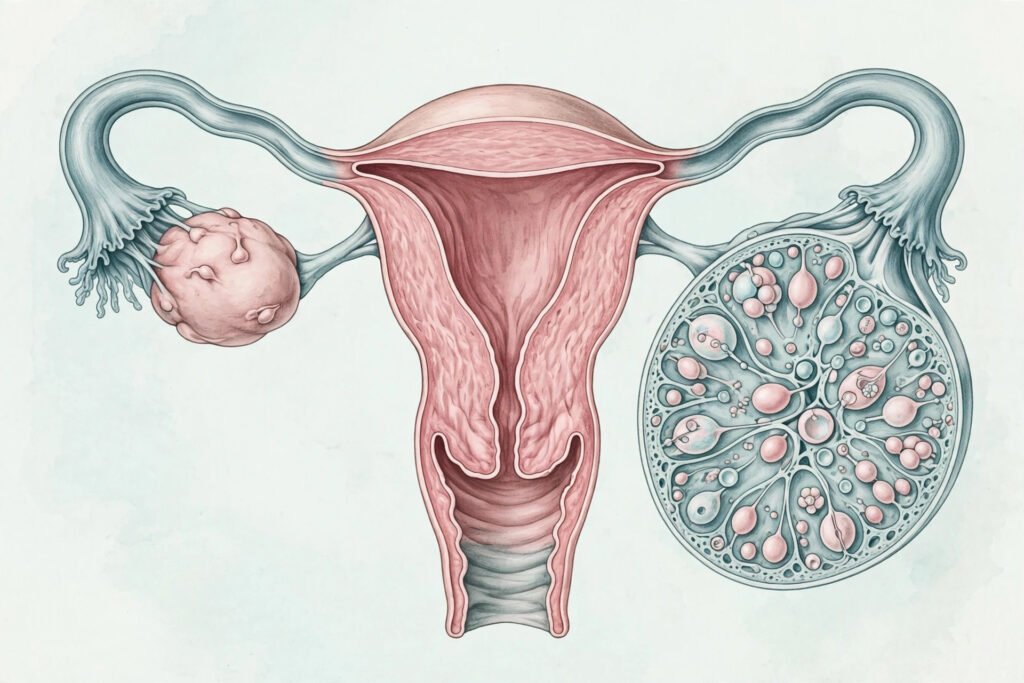
PCOS is a hormonal disorder in which the ovaries produce higher-than-normal levels of androgens — the group of hormones often called “male hormones,” though every woman makes small amounts too. The condition is named for the cluster of tiny fluid-filled follicles that can form on the ovaries; people commonly call these cysts, and they are typically spotted on an ultrasound. Despite the name, these are not true cysts and do not need to be present for a diagnosis — some women with PCOS have normal-looking ovaries, and some women with polycystic-looking ovaries do not have the syndrome.
Doctors commonly use the Rotterdam criteria: PCOS is diagnosed when at least two of three features are present — (1) irregular or absent ovulation, (2) signs of excess androgens (on blood tests or visible as hair growth and acne), and (3) polycystic ovaries seen on ultrasound — after other conditions that can mimic it have been ruled out. PCOS is not rare and it is not a single symptom; it is a whole-body condition that affects metabolism, fertility, skin, hair, and long-term health.
Causes & Risk Factors
No single cause has been pinned down, but researchers have identified several interacting drivers:
Insulin resistance. A large share of women with PCOS — including those at a healthy weight — do not respond to insulin as they should. Their bodies answer by releasing more of the hormone, and that surplus signals the ovaries to step up androgen production. This is why PCOS is so closely tied to weight gain and to a higher risk of type 2 diabetes later in life.
Excess androgens. Higher testosterone and related hormones disrupt ovulation — follicles start to develop but do not release an egg — and cause the visible signs: facial and body hair growth (hirsutism), acne, and thinning hair at the crown.
Low-grade inflammation. Women with PCOS tend to show higher levels of inflammatory markers, which may further stimulate androgen production.
Genetics. PCOS runs in families. Having a mother or sister with PCOS noticeably raises the odds, suggesting inherited susceptibility, though no single “PCOS gene” has been found.
Risk factors include a family history of PCOS or type 2 diabetes, and excess weight — which does not cause PCOS on its own but can worsen insulin resistance and symptoms. Lean women can have PCOS too.
Symptoms
PCOS looks different from woman to woman, and symptoms often creep in during the teens or twenties:
- Irregular periods — fewer than eight periods a year, cycles longer than 35 days, very heavy bleeding, or periods that stop altogether.
- Excess hair growth (hirsutism) — coarse, dark hair on the face, chin, chest, or back.
- Acne — persistent, often along the jawline, chin, and upper back, resistant to usual treatments.
- Hair thinning — widening part or thinning at the crown (female-pattern hair loss).
- Weight gain or difficulty losing weight, especially around the abdomen.
- Darkened, velvety skin patches (acanthosis nigricans) — usually at the neck, armpits, or groin, a visible clue of insulin resistance.
- Difficulty conceiving — because ovulation is irregular or absent.
- Mood changes — anxiety and depression are more common in women with PCOS, and sleep apnoea occurs more often too.
Tests & Diagnosis
There is no single blood test that says “you have PCOS.” Diagnosis is a careful process of matching the clinical picture and excluding lookalikes such as thyroid disorders, high prolactin, or adrenal problems.
Medical history and physical exam. Your doctor will ask about menstrual patterns, hair growth, acne, weight changes, and family history, and check for signs of excess androgens.
Pelvic ultrasound. A transvaginal or abdominal ultrasound looks for polycystic ovaries — typically defined as many small follicles or an enlarged ovarian volume. It also checks the uterine lining, which can thicken when periods are rare.
Blood tests. Common ones include total and free testosterone (and sometimes DHEA-S) to document high androgens; LH and FSH levels, where an elevated LH-to-FSH ratio supports the diagnosis; and tests to rule out other causes — TSH for thyroid disease and prolactin for pituitary issues. Because of the metabolic link, doctors also commonly check fasting glucose or an oral glucose tolerance test, HbA1c, and a lipid profile.
Blood pressure and weight are recorded as part of assessing long-term cardiovascular risk.

Treatment Options
Treatment is tailored to the symptoms that bother you most and whether pregnancy is a goal — there is no one-size-fits-all prescription.
Lifestyle therapy comes first. Clinical experience shows that shedding even a small percentage of body weight can restart regular ovulation for many women, while also improving insulin sensitivity and lowering androgen levels. Doctors recommend it as the foundation before or alongside medication.
Combined oral contraceptives. Birth control pills containing estrogen and progestin are often first-line for women not trying to conceive: they regulate periods, lower androgen levels, clear acne, and slow unwanted hair growth.
Metformin. Originally a diabetes drug, metformin improves insulin sensitivity and is commonly used in PCOS — especially when there is impaired glucose tolerance — to help regulate cycles and support weight management.
Anti-androgen medications. Drugs such as spironolactone can reduce hirsutism and hair loss, usually combined with contraception because they must not be taken during pregnancy.
Fertility treatments. For women trying to conceive, weight management plus ovulation-inducing medications such as letrozole or clomiphene are standard first steps; many women with PCOS conceive successfully with treatment.
Cosmetic and dermatologic care. Laser hair removal, electrolysis, and dermatologist-guided acne treatment address the visible symptoms while medical therapy works underneath.

Lifestyle Management & Prevention
Daily habits carry real weight in PCOS — sometimes as much as medication:
- Eat for insulin sensitivity. No single “PCOS diet” is proven best, but most specialists favour balanced meals built on vegetables, whole grains, legumes, lean protein, and healthy fats, with limited refined sugar and sugary drinks. Smaller, regular meals can steady blood sugar.
- Move regularly. A mix of aerobic exercise and strength training improves insulin sensitivity, supports weight control, and lifts mood. Aim for consistency over intensity.
- Protect your sleep. Poor sleep worsens insulin resistance and cravings. Keep a regular schedule and get evaluated if you snore heavily or feel unrefreshed — sleep apnoea is underdiagnosed in PCOS.
- Manage stress. Chronic stress raises cortisol, which works against blood-sugar control. Whatever reliably calms you — walking, prayer, breathing exercises — counts.
- Track your cycles. A simple period-tracking app or calendar helps you and your doctor see patterns and judge whether treatment is working.
PCOS cannot be entirely prevented, but maintaining a healthy weight, staying active, and getting early evaluation for irregular periods can keep symptoms milder and reduce long-term risks such as type 2 diabetes and endometrial problems.
When to See a Doctor
One long-term risk deserves emphasis: when ovulation rarely happens, estrogen keeps stimulating the uterine lining month after month with no progesterone to counterbalance it, and over years this unopposed stimulation can cause abnormal thickening known as endometrial hyperplasia. Regular medical follow-up and treatments that induce periodic bleeding protect against this — another reason not to ignore missing periods.
Key Takeaways
- PCOS is a common hormonal disorder diagnosed by a combination of irregular ovulation, excess androgens, and polycystic ovaries — no single test defines it.
- Insulin resistance sits at the heart of PCOS, linking it to weight gain and higher diabetes risk.
- Diagnosis involves ultrasound, hormone blood tests (testosterone, LH/FSH), and ruling out thyroid and prolactin disorders.
- Treatment is personalised: lifestyle change first, then contraceptives, metformin, anti-androgens, or fertility medications as needed.
- Even modest weight loss can restore ovulation and markedly improve symptoms.
- Do not ignore absent periods — long-term follow-up protects the uterine lining and metabolic health.
Reviewed by
Dr. Ata Ullah — MBBS, MD Medicine, Physician Consultant.
“Your Health, Our Responsibility.”
Medical disclaimer: This article is for informational purposes only and is not a substitute for professional medical advice, diagnosis, or treatment. Always seek the advice of your physician or another qualified health provider with any questions you may have regarding a medical condition.
Online Consultation: Dr. Ata Ullah (MBBS, MD Medicine), Physician Consultant / Medical Specialist — WhatsApp: 0315 7148181 — Consultation Fees: $30