
Introduction
On 9 November 2026, the United States Food and Drug Administration (FDA) ordered a new warning on every GLP-1 weight-loss and diabetes medicine: Ozempic, Wegovy, Mounjaro, Zepbound, Rybelsus, Trulicity, Saxenda, Victoza, and the new once-daily pill Foundayo. The warning concerns NAION, short for non-arteritic anterior ischemic optic neuropathy, a rare eye condition that can cause sudden, painless, often permanent vision loss in one eye. The risk is very small, about 6 cases in every 100,000 people per year of treatment, and the FDA has not told anyone to stop their medicine. Medically reviewed by Dr. Ata Ullah, MD (Medicine).
What the FDA Announced on 9 November 2026
In a Drug Safety Communication, the FDA said it had reviewed 126 clinical trials covering 134,253 patients and found 15 probable cases of NAION: 10 among people taking a GLP-1 drug and 5 among people taking a placebo. Because cases have been reported for every GLP-1 product, the FDA is requiring the risk to be added to the Warnings and Precautions section. This guide explains what NAION is, who is most at risk, the symptoms that need same-day care, and the tests doctors use.
What Causes NAION
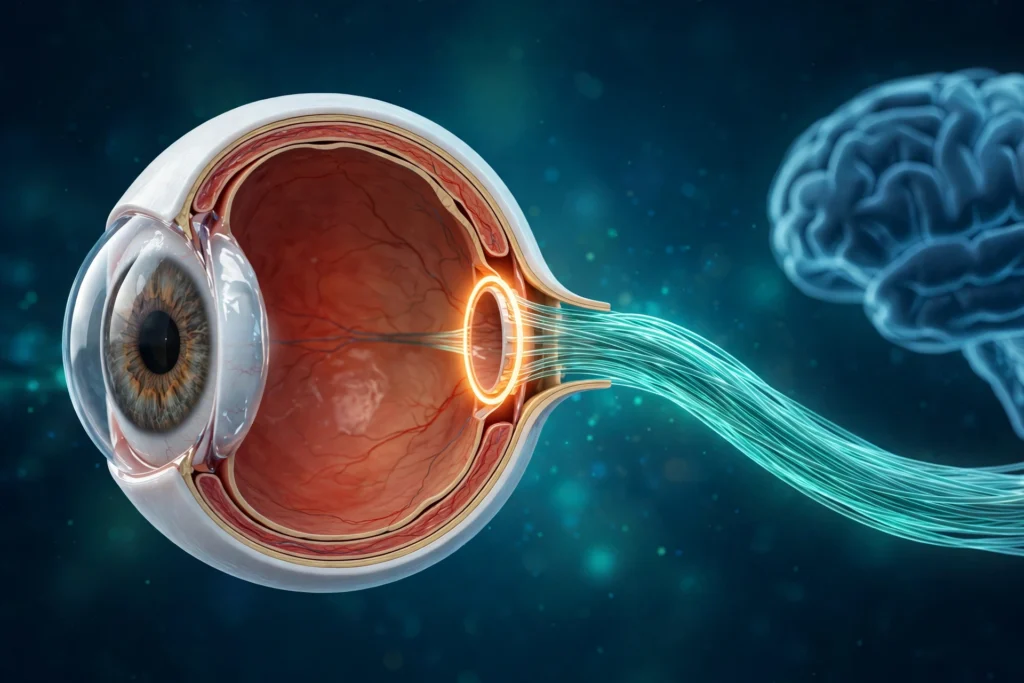
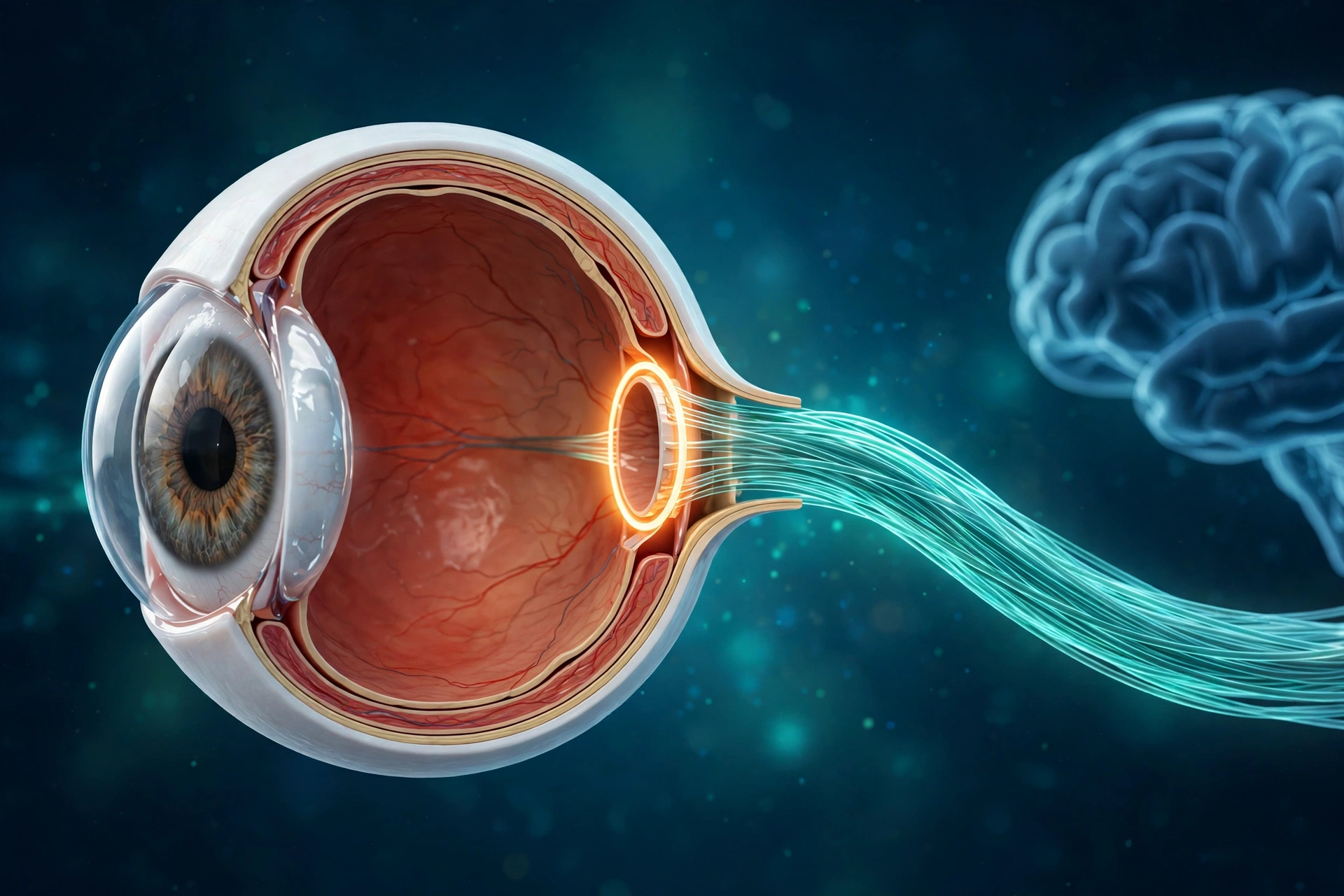
NAION happens when blood flow to the front of the optic nerve falls too low. The optic nerve carries every visual signal from eye to brain, and its front end is fed by tiny vessels called the short posterior ciliary arteries. When they deliver too little blood, the nerve fibers are starved of oxygen and swell. The best-known risk factors are conditions that damage small blood vessels: diabetes, high blood pressure, high cholesterol, and smoking. Our guides to type 2 diabetes warning signs and lowering cholesterol without medication explain how to lower those risks.
Sleep apnea also matters: breathing pauses through the night drop blood oxygen and strain the optic nerve. Eye shape matters too: some people are born with a small, crowded optic disc, a disc at risk, where nerve fibers pass through a narrow opening with no room to swell. Age is the strongest single factor: NAION is the most common cause of sudden optic nerve injury in people over 50. Whether GLP-1 medicines add risk is still uncertain: the FDA found no mechanism in animal studies, and the conditions that lead people to take these drugs overlap heavily with NAION risk factors, so the risk is called potential, not proven. The concern began with a 2024 JAMA Ophthalmology study linking semaglutide to NAION.
How NAION Develops in the Body
The damage follows a short, self-reinforcing cycle. Blood pressure naturally falls at night, and in a person with a crowded disc and narrowed small vessels, flow through the short posterior ciliary arteries can drop below what the optic nerve head needs. Starved of oxygen, the nerve fibers swell. Because the disc sits in a tight opening, the swelling has nowhere to go, so it squeezes the small vessels further and cuts the blood supply more. This is why vision loss is usually noticed on waking, when blood pressure is lowest and low flow lasts longest.
In the following days, the swollen disc is visible to an eye doctor. The swelling usually settles over about two months, but by then many damaged nerve fibers have died, and the disc often looks pale and thinned, a change called optic atrophy. Vision sometimes improves as swelling fades: in the large trial of untreated patients, about 4 in 10 gained some back. But for many, the lost vision stays lost, so doctors focus on protecting the other eye. About 15 in 100 people who have NAION in one eye later develop it in the other, so follow-up matters as much as the first visit.
Prevention: Lowering Your Risk
The most effective prevention is controlling the blood-vessel risks that feed NAION. Keep blood sugar, blood pressure, and cholesterol in the ranges your doctor sets for you, take prescribed medicines regularly, and have them checked at every visit. If you have diabetes, a yearly dilated eye examination is already recommended, and it also gives the doctor a chance to see whether your optic disc is small and crowded. Quit smoking, because smoke narrows small vessels and is one of the few risk factors you can remove completely. Keep alcohol modest and weight in a healthy range, since excess weight worsens blood pressure, blood sugar, and sleep apnea.
Sleep apnea deserves special attention. If you snore loudly, wake up tired, or a partner has seen you stop breathing at night, ask your doctor about a sleep test. Treating apnea with airway pressure therapy steadies oxygen through the night and removes one stress on the optic nerve. Our guide to sleep apnea symptoms explains the warning signs. Before starting a GLP-1 medicine, tell your doctor about any eye disease, previous vision loss, or sleep apnea, and ask whether a baseline eye check makes sense for you, especially if you are over 50 with several risk factors. Do not change the timing of blood pressure medicines on your own, because night-time blood pressure matters here: raise any question about it with your doctor. Finally, learn the symptom itself, because the only prevention that works after NAION starts is fast action.
Symptoms and Identification
The hallmark of NAION is sudden, painless loss of vision in one eye, most often noticed first thing in the morning. Vision may blur or dim across part of the field, often the lower half, as if a grey patch has settled over it. Colors look washed out in the affected eye, and seeing in dim light becomes harder. There is usually no pain, no redness, and no discharge, which is why people sometimes wait, hoping it will clear. It usually does not. The other eye is almost always normal at first, although both eyes can be affected together after major surgery, dialysis, or heavy blood loss, when blood pressure falls.
Doctors must separate NAION from a look-alike that is a true emergency. Arteritic anterior ischemic optic neuropathy is caused by inflamed arteries, usually giant cell arteritis, and it can take the second eye within days unless treated. The clues are headache, scalp tenderness, pain in the jaw while chewing, shoulder aches, and fever, usually in someone over 60.
| Feature | NAION (non-arteritic) | Arteritic AION |
|---|---|---|
| Vision loss | Sudden, painless, one eye | Sudden, one eye, can affect the second eye within days |
| Other symptoms | Usually none | Headache, scalp tenderness, jaw pain, fever |
| Cause | Low blood flow to the optic nerve | Inflamed arteries starving the optic nerve |
| Urgency | Same-day eye care | Emergency: treatment the same day |
Any sudden vision loss needs same-day care, whatever the cause. A curtain over part of the vision, with flashes and new floaters, can mean a detached retina. Eye pain with redness, halos around lights, and nausea can mean acute glaucoma. Sudden vision loss with face droop, arm weakness, or slurred speech can mean a stroke: call emergency services immediately. Chest pain or severe breathlessness with vision changes also means calling emergency services at once.
Tests and Diagnosis
Diagnosis starts the same day, in an eye clinic or emergency department. The doctor first measures vision in each eye with a letter chart, tests color vision with dotted plates, and checks the pupils for a subtle sign called a relative afferent pupillary defect, where one pupil reacts weakly to light. Side-vision testing maps the missing area. Then the doctor dilates the pupils and looks at the back of the eye: in NAION the optic disc is swollen, sometimes with small hemorrhages around it, and often small and crowded. If the history and the swollen disc are typical, with the usual risk factors, no further test is needed to confirm the diagnosis.
Further tests are used when the picture is unclear or another cause must be ruled out. A formal visual field test, called perimetry, measures which parts of vision are missing and gives a baseline to compare later. Optical coherence tomography, or OCT, uses light to measure the nerve fiber layer around the disc and tracks how the swelling settles. Blood tests for inflammation, the erythrocyte sedimentation rate and C-reactive protein, are done the same day whenever giant cell arteritis is possible, because that diagnosis changes treatment completely. A dye test, fluorescein angiography, can show blood flow to the optic nerve head when the diagnosis is uncertain. An MRI scan of the brain and orbits is reserved for suspected optic neuritis, tumor, or stroke. Blood sugar and cholesterol are checked as part of the risk-factor review.
Treatment and Emergency Medicines
The honest truth first: no medicine or operation is proven to restore vision lost to NAION. The American Academy of Ophthalmology states that no treatment has been shown to improve the outcome, and steroid tablets are not recommended for NAION itself. An operation to cut the sheath around the optic nerve showed no benefit in a large trial. Doctors focus on protecting the eye that is still healthy: control blood pressure, blood sugar, and cholesterol, treat sleep apnea, and stop smoking. Follow-up visits repeat the vision and field tests and the OCT scan.
From the Clinic: What a Physician Would Tell You
Do not panic, and do not stop your medicine. The risk is tiny, about 6 cases in 100,000 people per year; stopping suddenly can send blood sugar and weight back up. The most useful action is simple: if you wake up and the vision in one eye has changed, get same-day eye care and tell the doctor you take a GLP-1 medicine. Mention sleep apnea, diabetes, and blood pressure. If you are over 50 with several risk factors, ask about a baseline eye check.
Emergency Medicines Guide
No emergency medicine reverses NAION. The medicines below are for the emergencies sudden vision loss can hide. Never take another person’s medicine: dosage must come from your doctor or pharmacist.
| Symptom | Medicine class |
|---|---|
| Sudden vision loss with headache, scalp tenderness, or jaw pain (possible giant cell arteritis) | Corticosteroid class, started the same day in hospital |
| Sudden vision loss with eye pain, redness, and halos (possible acute glaucoma) | Pressure-lowering eye-drop classes |
| Chest pain, pressure, or stroke signs with vision changes | Hospital-only blood-thinning and clot-dissolving medicine classes |
| High blood pressure, diabetes, or high cholesterol | Blood pressure, blood sugar, and cholesterol medicine classes |
If giant cell arteritis is suspected, treatment starts before the blood results come back, because waiting can cost the second eye. If NAION is confirmed, the focus shifts to the risk factors and regular follow-up. Tell your doctor about every medicine you take, including the GLP-1 drug.
What to Eat
Food helps here by protecting small blood vessels and steadying blood sugar, blood pressure, and cholesterol, the same risks that feed NAION. Leafy greens such as spinach and kale are the strongest choice: they supply lutein and zeaxanthin, pigments that collect in the eye, and natural nitrates that help blood vessels relax and carry more blood. Oily fish such as salmon and sardines, twice a week, add omega-3 fats that lower triglycerides and calm inflammation in vessel walls. A small handful of walnuts or almonds most days adds healthy fats and magnesium for steady blood pressure. Berries and citrus fruit add vitamin C for strong vessel walls.
Whole grains such as oats and brown rice, and beans and lentils, add fiber that slows the rise of blood sugar and helps cholesterol fall. Olive oil instead of butter adds monounsaturated fats, kinder to the arteries. Drink water through the day instead of sugary drinks, and keep salt moderate by cooking with herbs and spices rather than adding salt at the table. Eat the largest meal at midday and keep dinner lighter, finishing two to three hours before bed, so a full stomach does not worsen sleep apnea or disturb night blood pressure.
What to Avoid
Smoking is the first thing to stop: it narrows small vessels and is one of the few NAION risk factors you can remove completely. Do not stop a GLP-1 drug, a diabetes medicine, or a blood pressure medicine abruptly because of the new warning: sudden stops can spike blood sugar and blood pressure, and any change should be agreed with your doctor. Never ignore a morning change in vision and hope it clears by itself; the hours after sudden vision loss are when another cause, such as giant cell arteritis, must be caught. Avoid so-called eye vitamins that claim to prevent NAION: no supplement has been shown to prevent it, and the money is better spent on an eye examination. Avoid heavy alcohol, very salty processed food, and large late-night meals, which disturb blood pressure, blood sugar, and sleep. Never buy steroids or blood-thinning medicines online to treat yourself.
Frequently Asked Questions
Should I stop taking Ozempic, Wegovy, or Mounjaro because of this warning?
No, not on your own. The FDA did not advise anyone to stop these medicines, and the risk is very small, about 6 cases in 100,000 people per year. Stopping suddenly can push blood sugar and weight back up. Keep taking your medicine, learn the warning symptom, sudden painless vision loss in one eye, and talk to your doctor if you are worried.
How common is NAION in people who take GLP-1 drugs?
In the FDA review of 126 clinical trials, the rate was 6.4 cases per 100,000 person-years with a GLP-1 drug, against 3.8 per 100,000 with a placebo or another diabetes drug. For comparison, NAION occurs in about 2 to 10 people per 100,000 over 50 every year, causing roughly 6,000 new cases a year in the United States. The FDA describes the extra risk as potential, not proven.
Can vision lost to NAION come back?
Sometimes, partly. As disc swelling settles over about two months, some people regain part of their vision: in the large trial of untreated patients, about 4 in 10 gained some back. But many do not recover what was lost; no medicine or operation is proven to restore it. Doctors focus instead on protecting the other eye: blood pressure, blood sugar, cholesterol, and sleep apnea.
What should I do if my vision suddenly changes in one eye?
Get same-day eye care or go to an emergency department; do not wait to see if it clears. Note when it started, which eye is affected, and whether there is pain, headache, scalp tenderness, or jaw pain, and bring a list of your medicines. The doctor will check your vision, dilate your pupils, and examine the optic disc, and order inflammation blood tests the same day if giant cell arteritis is possible.
Does the warning apply to the new weight-loss pill Foundayo?
Yes. The FDA warning covers the whole GLP-1 class, including the once-daily pill orforglipron, sold as Foundayo, semaglutide in Ozempic, Wegovy, and Rybelsus, tirzepatide in Mounjaro and Zepbound, liraglutide, dulaglutide, and exenatide. Cases of NAION have been reported for every GLP-1 product on the market. Our guide to orforglipron for sleep apnea explains the pill and its trial results in full.
A Final Word
This warning is a reason to be alert, not afraid. Millions of people take these medicines, and NAION remains rare. Know the one symptom that matters, sudden painless vision loss in one eye, and act the same day if it appears. Keep taking your prescribed medicine unless your doctor says otherwise.
Medical Reviewer
Dr. Ata Ullah, MBBS, MD (Medicine) — Physician Consultant, Senior Medical Officer at DHQ Hospital, Layyah, Pakistan.
Motto: “Your Health, Our Responsibility.”
Online Consultation: Dr. Ata Ullah (MBBS, MD Medicine), Physician Consultant / Medical Specialist — WhatsApp: 0315 7148181 — Consultation Fees: $30
Pingback: Tirzepatide: 21% Weight Loss, Side Effects & Who Should Take It (2026) - CureWiser