

Introduction
Every cholesterol report carries the same two letters: LDL and HDL. Most people know one is called bad and the other good, and stop there — but LDL and HDL are not two kinds of cholesterol at all. The cholesterol inside them is identical; what differs is the particle carrying it and what it does when it gets there. This guide explains both numbers: what they are, how each affects your arteries, how to read your lipid panel, which targets matter, and what moves them. Medically reviewed by Dr. Ata Ullah, MD (Medicine).
What Changed in 2026
Awareness is rising: a March 2026 CDC study found the share of American adults who knew they had high cholesterol rose from 29.2 to 33.2 percent between 2019 and 2023. Even so, about 86 million American adults still have total cholesterol above 200 milligrams per decilitre — numbers worth understanding, because they are heart risks you can measure, track, and change.
What Raises LDL and What Lowers HDL
LDL climbs mostly because of food, weight, and genes. Saturated fat — red meat, butter, cheese, and palm oil — pushes the liver to make more LDL. Trans fat, in some fried foods, pastries, and processed snacks, raises LDL and lowers HDL at the same time — the worst fat of all. Extra weight, especially around the waist, raises LDL and triglycerides together; too little movement, smoking, and type 2 diabetes push LDL up as well. Some medicines add to it, including steroids and certain water tablets, and an underactive thyroid or kidney disease can raise LDL too — worth investigating when a new reading is high. LDL also rises with age, and in women it often jumps after the menopause.
HDL falls for different reasons. Smoking is the biggest single drag on HDL, and quitting is the fastest way to lift it. Excess weight and a sedentary life lower it, and high triglycerides pull HDL down with them. Type 2 diabetes lowers HDL, and very low-fat diets can lower it too. Genes set the starting point for both: about one person in 250 inherits familial hypercholesterolaemia, in which LDL runs very high from birth and needs treatment early, whatever the diet.
How LDL Damages Arteries — and How HDL Protects Them
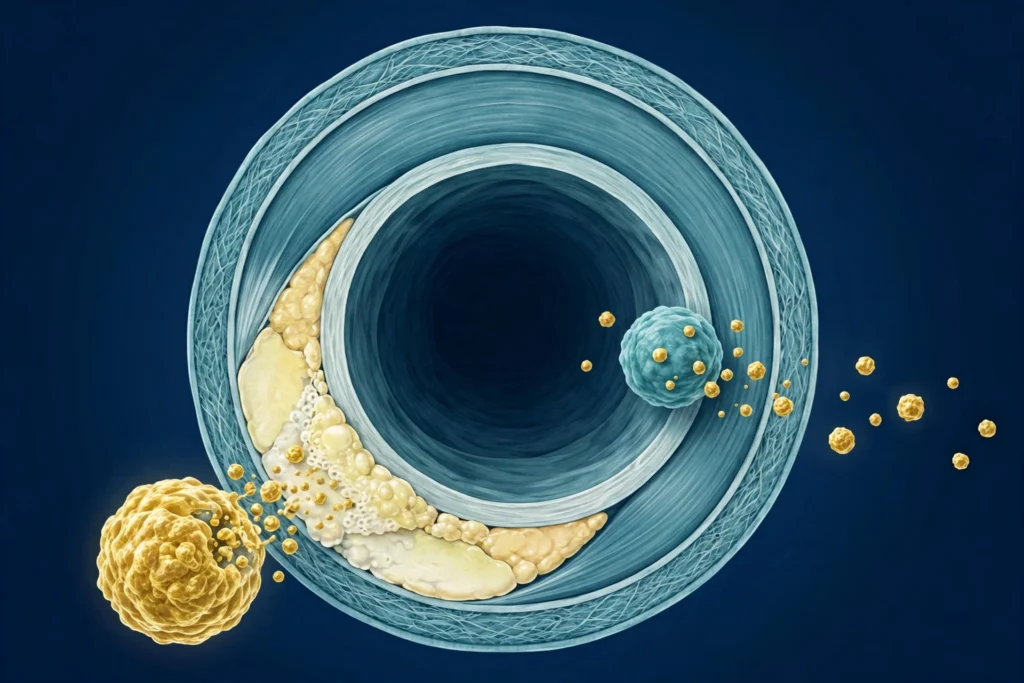
LDL particles are small enough to slip through an artery wall’s inner lining. Once inside, they get trapped and oxidised. White blood cells swallow them and die as foam cells, leaving a fatty streak. Over years, a cap forms over the deposit and calcium hardens it into plaque. If the cap cracks, a clot forms in minutes — a heart attack in a coronary artery, a stroke in a brain artery.
The proof that LDL itself causes this is overwhelming: people with genes that keep LDL low for life have far less heart disease, and people with genes that raise it have far more. A pooled analysis of 26 trials and 170,000 people, published in The Lancet, found every reduction of 1.0 millimole per litre in LDL cut major vascular events by 22 percent and all-cause deaths by 10 percent, with no lower threshold.
HDL works in the opposite direction, collecting excess cholesterol from artery walls and returning it to the liver. But the HDL number measures cargo, not capability: drugs that raised HDL sharply — the CETP inhibitors — failed to prevent heart attacks, and one increased deaths. Niacin raised HDL too and also failed, so HDL is a useful risk marker, not a drug target.
Prevention: Keeping Both Numbers on Your Side
Prevention starts with the food pattern, not a single superfood. A Mediterranean or DASH diet — vegetables and fruit at every meal, whole grains, beans and lentils, fish twice a week, olive oil instead of butter, nuts most days — lowers LDL and supports HDL. Keep saturated fat low with lean meat, skinless poultry, and low-fat dairy, and cut trans fat out entirely by checking labels for partially hydrogenated oils. Soluble fibre helps directly: oats, barley, psyllium, beans, and apples bind cholesterol in the gut. Our guide to lowering cholesterol without medication sets out the full plan.
Movement is the strongest lever on HDL: about 150 minutes of brisk walking a week, plus strength training twice a week, raises HDL by roughly 5 to 10 percent and lowers triglycerides too. Losing even 5 to 10 percent of body weight improves all three numbers at once — the single change that helps every line on the report. Seven to nine hours of sleep keeps hunger hormones steady. Do not smoke, and keep alcohol modest: heavy drinking raises triglycerides and drags HDL down.
Finally, know your numbers early: a lipid panel from age 20, repeated every four to six years if normal, sooner with a family history of early heart disease, diabetes, or high cholesterol. If your father or brother had a heart attack before 55, or your mother or sister before 65, tell your doctor — that history changes your target and your timetable.
Reading Your Lipid Panel: What Each Number Means
High cholesterol has no symptoms — nothing you can feel — which is why the blood test is the only way to know. The damage is silent for years; the first symptom is often the heart attack or stroke itself. A few people get visible clues: yellowish patches around the eyelids, called xanthelasma, or lumps on the tendons, called xanthomas. Any of these deserves a prompt appointment.
Targets are in milligrams per decilitre, millimoles per litre in brackets.
| Number | What it is | Target for most adults |
|---|---|---|
| Total cholesterol | All the cholesterol in your blood | Below 200 (5.2) |
| LDL cholesterol | Cholesterol carried to the tissues — lower this number | Below 100 (2.6); below 70 (1.8) if risk is very high |
| HDL cholesterol | Cholesterol carried back to the liver — keep this number up | Above 40 (1.0) men; above 50 (1.3) women |
| Triglycerides | Blood fat after meals; high levels drag HDL down | Below 150 (1.7) |
| Non-HDL cholesterol | Total minus HDL — all harmful particles | 30 above your LDL target (below 130 / 3.4) |
Two derived numbers often tell the truth when LDL alone does not. Non-HDL cholesterol is total cholesterol minus HDL, capturing every harmful particle in one figure — the number to watch when triglycerides are high, because the standard LDL calculation becomes unreliable then. Apolipoprotein B, or ApoB, counts the particles themselves, and a 2025 review of 15 studies and 590,000 people found ApoB and non-HDL cholesterol predicted heart risk better than LDL cholesterol alone. Lipoprotein(a), or Lp(a), is inherited: about one person in five has a high level.
Take a total of 230 with an HDL of 50. The total looks only mildly high, but the non-HDL figure is 180 — well above the target of 130. Never judge the report by the total alone.
Tests and Diagnosis: The Lipid Panel and Beyond
The lipid panel is one blood draw measuring total cholesterol, LDL, HDL, and triglycerides. It is usually done after nine to twelve hours without food, because a recent meal raises triglycerides and can distort the LDL calculation, often worked out from the other numbers rather than measured directly. European guidance now accepts a non-fasting sample, with a fasting repeat only when triglycerides come back very high. If the first result is borderline, repeat it after four to twelve weeks — cholesterol varies day to day, and one reading can mislead.
Your doctor reads the panel alongside your other risks. Blood pressure is measured, HbA1c checks blood sugar — diabetes and high cholesterol travel together, as our guide to type 2 diabetes warning signs explains — and kidney and thyroid function are checked, because both can push LDL up. Ask for an ApoB test when the LDL number and the overall risk do not agree, as in diabetes or with high triglycerides. An Lp(a) test is done once and never repeated, because the level is set by your genes.
Two further tests settle close decisions. A coronary calcium scan shows whether plaque is already in the heart arteries: zero argues against starting a medicine, a high score argues for it. Genetic testing for familial hypercholesterolaemia is offered when LDL is above 190, with tendon xanthomas, or when a close relative had heart disease unusually young — finding the gene matters because the whole family should then be tested, including children.
Treatment: What Moves LDL Down and HDL Up — and When Medicine Joins In
Lifestyle is the first treatment, and its effects are measurable. Cutting saturated fat and adding soluble fibre and plant sterols each trims LDL by roughly 5 to 10 percent, and regular aerobic exercise raises HDL by roughly the same amount. Losing weight improves all three numbers, and quitting smoking raises HDL. These changes are the base of every plan.
Medicine joins in when the risk justifies it. A statin comes first: the statin class blocks cholesterol production in the liver, so the liver pulls more LDL out of the blood, typically cutting LDL by about a third to a half. If LDL stays above target, ezetimibe is added, cutting LDL by about a fifth more. For very high-risk people, or those who cannot tolerate a statin, the PCSK9 inhibitor class cuts LDL by half. Our general guide to lowering cholesterol covers the medication option in full.
From the Clinic: What a Physician Would Tell You
Chase the LDL number, not the ratio: a high HDL does not cancel out a high LDL. Do not buy supplements that promise to raise HDL — the drugs that did it best failed. Do not stop a statin because a friend had muscle aches: tell your doctor, because a different statin usually solves it. An LDL above 190 needs a prompt appointment and family history check.
Emergency Medicines Guide
Cholesterol has no emergency medicine. The medicines below are for the heart attack or stroke it can cause, given in hospital only. Never take another person’s medicine: dosage must come from your doctor or pharmacist.
| Symptom | Medicine class |
|---|---|
| Chest pain or pressure, pain to arm or jaw | Emergency care at once; hospital antiplatelet and clot-dissolving classes |
| Sudden weakness, slurred speech, face droop | Emergency care at once; hospital assessment only |
| LDL above 190, or family history of early heart disease | Prompt appointment; cholesterol-lowering class |
What to Eat
Soluble fibre is the most direct food tool against LDL, because it binds cholesterol in the gut and carries it out. Oats and barley are the richest everyday sources, along with psyllium husk, beans, lentils, chickpeas, and apples — a bowl of oats with an apple covers a good part of the daily target. Plant sterols and stanols, found in nuts, seeds, and fortified spreads, block cholesterol absorption in the same way and add a further cut of roughly a tenth. Walnuts and almonds combine fibre, sterols, and healthy fats in one food, and a small handful a day is enough.
Oily fish — salmon, sardines, and mackerel twice a week — supplies omega-3 fats that lower triglycerides and let HDL rise. Olive oil, avocado, and rapeseed oil provide monounsaturated fats that support HDL without raising LDL, so they are the right replacement for butter rather than an addition to it. Soy foods, lentils, and beans add protein without saturated fat, and fruit and vegetables add fibre and volume that make smaller portions satisfying. Eat this way most days, and the numbers move steadily over two to three months, which is when the repeat test is worth doing.
What to Avoid
Trans fat is the one thing to cut out completely: it raises LDL and lowers HDL at the same time. Check labels for partially hydrogenated oils in pastries, biscuits, fried snacks, and some margarines. Keep saturated fat low rather than zero — fatty cuts of meat, processed meats such as sausages and bacon, butter, full-fat cheese, and coconut and palm oil are the main sources, and trimming them is worth more than any single superfood. Sugary drinks and excess alcohol raise triglycerides, which drag HDL down, so water, unsweetened tea, and modest alcohol are the safer pattern. Do not smoke: besides everything else, smoking lowers HDL and damages the artery lining that LDL then enters. And avoid crash diets — rapid weight loss followed by regain leaves the numbers worse than a slow, steady loss. Swap butter for olive oil and keep portions moderate — small, steady changes beat short-lived extremes.
Frequently Asked Questions
What is a good LDL cholesterol level?
For most adults, below 100 milligrams per decilitre (2.6 millimoles per litre) is the target, and below 70 (1.8) for people at very high risk, such as after a heart attack. The right target depends on your overall risk: a healthy person with an LDL of 110 may need only food and activity, while a person with diabetes and the same number may need medicine.
What is a good HDL cholesterol level?
Above 40 milligrams per decilitre (1.0 millimole per litre) for men and above 50 (1.3) for women. Higher is generally better, but not endlessly so: a large Danish study found very high HDL, above roughly 90 to 100, was also linked to higher death rates. HDL is a risk marker, not a target to chase with drugs — no medicine is prescribed simply to raise it.
Can LDL be high if total cholesterol is normal?
Yes — the most common trap in reading a report. Total cholesterol is LDL plus HDL plus the rest, so a low HDL can hide a high LDL: a total of 200 with an HDL of 35 means an LDL near 140. That is why doctors look at non-HDL cholesterol — total minus HDL — which captures every harmful particle in one number.
Does exercise raise HDL?
Yes. Regular aerobic exercise — brisk walking, cycling, swimming — raises HDL by roughly 5 to 10 percent over a few months, and it lowers triglycerides at the same time. The effect builds with consistency rather than intensity, so 150 minutes a week of brisk walking beats occasional hard sessions. Strength training twice a week adds to the benefit over time.
What is non-HDL cholesterol, and what is ApoB?
Non-HDL cholesterol is total cholesterol minus HDL, counting every harmful particle in a single number — the figure to trust when triglycerides are high. ApoB goes one step further: it counts the particles themselves, since each harmful particle carries exactly one ApoB molecule. A 2025 review of 15 studies and 590,000 people found both predicted heart risk better than LDL alone.
Should I worry about a low HDL if my LDL is fine?
A low HDL is a warning light, not a diagnosis. It usually travels with high triglycerides, excess weight around the waist, smoking, or too little activity, and fixing those usually lifts HDL on its own. Ask your doctor to check triglycerides, blood sugar, and blood pressure too, because the pattern matters more than the single number. No drug is prescribed just for a low HDL.
A Final Word
Your cholesterol report is not a verdict, it is a map. LDL tells you how much is being delivered into your arteries, HDL tells you how much is being carried away. Know your numbers, and ask your doctor about the rest.
Medical Reviewer
Dr. Ata Ullah, MBBS, MD (Medicine) — Physician Consultant, Senior Medical Officer at DHQ Hospital, Layyah, Pakistan.
Motto: “Your Health, Our Responsibility.”
Online Consultation: Dr. Ata Ullah (MBBS, MD Medicine), Physician Consultant / Medical Specialist — WhatsApp: 0315 7148181 — Consultation Fees: $30