
Introduction
Mpox is back in the news: Brazil has reported 1,009 confirmed cases in 2026 and its first mpox death of the year, and the virus that caused a global emergency in 2022 is still circulating in more than 100 countries. Mpox, formerly called monkeypox, is a viral infection that causes fever, swollen glands and a distinctive rash. Most people recover in two to four weeks, but it can be serious for children, pregnant women and people with weak immune systems. This guide explains what mpox is, how it spreads, what the rash looks like, and how it is tested and treated. Medically reviewed by Dr. Ata Ullah, MD (Medicine).
What Changed in 2026
The World Health Organization counted 65,784 confirmed cases across 105 countries from January 2025 to July 2026, and a newer strain — clade Ib — is now spreading beyond Africa. Mpox is one of several viruses health agencies are watching in 2026, alongside the Ebola outbreak in Central Africa. The risk for the general public remains low.
What Causes Mpox and How You Catch It
Mpox is caused by the monkeypox virus, known as MPXV, an Orthopoxvirus in the same family as smallpox. The virus comes in two main types, called clades. Clade I, found in Central and East Africa, causes more severe illness; its sub-type clade Ib emerged in eastern Congo in 2023 and has since spread beyond the region. Clade II, found in West Africa, is milder, and its sub-type clade IIb drove the 2022 outbreak. Scientists have also found a rare recombinant strain carrying pieces of both clades, in two travellers.
The virus lives in animals in Central and West Africa, most likely rodents, although the exact host is unknown. People catch it from animals through bites, scratches or handling infected animals. Once it reaches people, it spreads person to person through close contact: skin-to-skin contact, sex, kissing, face-to-face contact, and living in the same household. It also spreads through contaminated bedding, clothing or towels, respiratory droplets in prolonged close contact, mother to baby, and needle injuries. Anyone in close contact with a case can catch it, says the World Health Organization’s mpox fact sheet — but the risk is highest for household members, sexual partners and health workers, and severe illness is most likely in children, pregnant women and the immunocompromised.
How Mpox Develops in the Body
The virus enters through broken skin, the eyes, nose or mouth, or by breathing in droplets during close contact. It first multiplies where it entered, then travels to the nearby lymph nodes — which is why swollen glands are such a hallmark of mpox. From there it enters the bloodstream, bringing fever and aches, and then reaches the skin, where the rash appears.
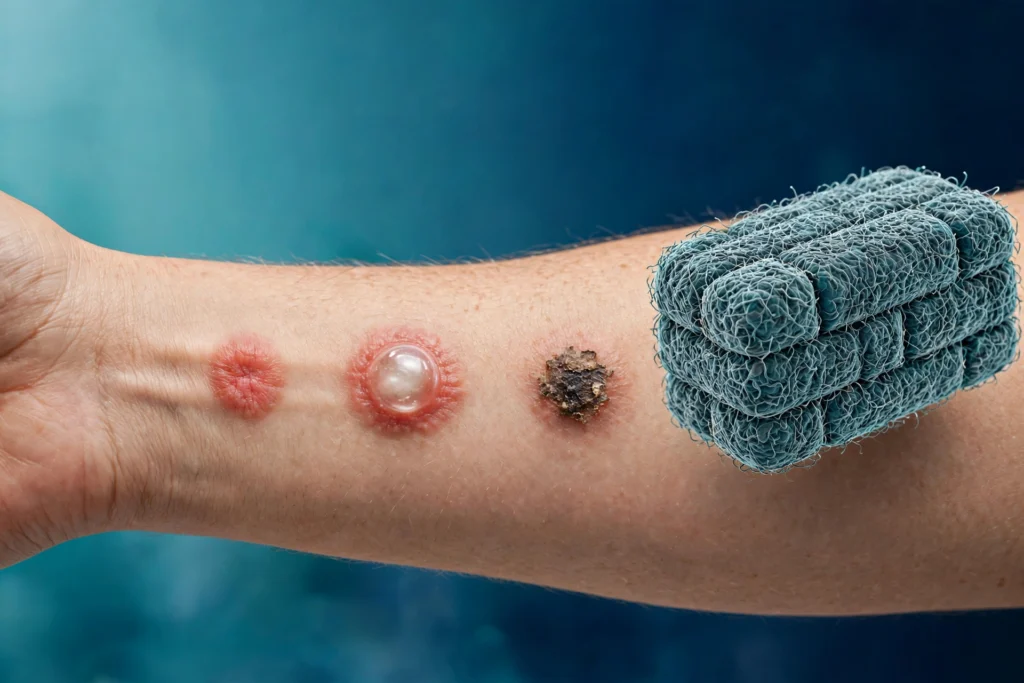
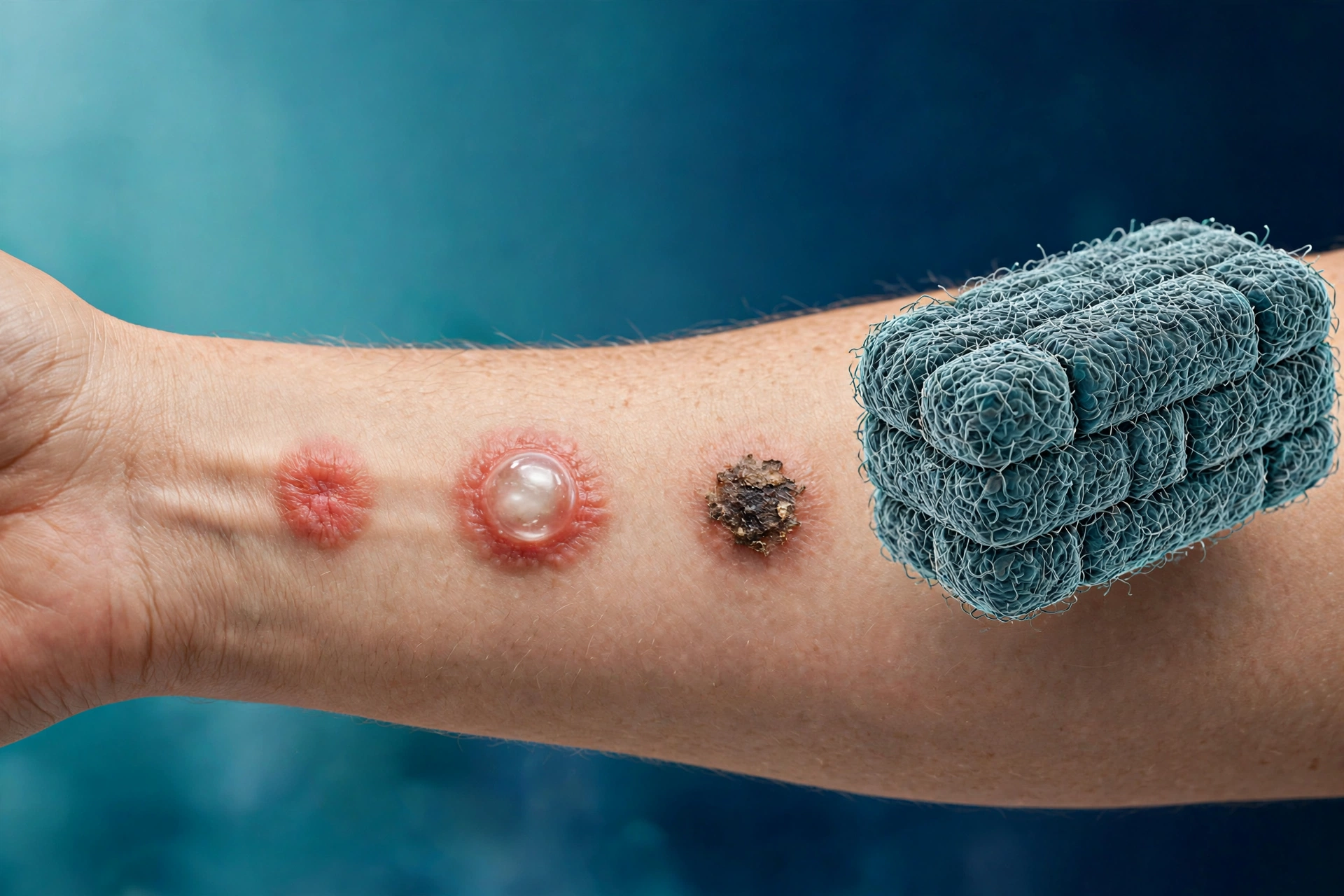
Symptoms usually begin within a week of exposure, although incubation can stretch from 1 to 21 days. The rash moves through clear stages: flat red spots, raised bumps, fluid-filled blisters, pus-filled sores, then crusts that dry, scab over and fall off, leaving fresh skin. There may be only a few lesions, or several hundred. You stay infectious from the first symptoms until every scab has fallen off — usually two to four weeks.
Most people recover fully, but sores can become infected, the lungs or eyes can be affected, and severe pain, rectal inflammation and, rarely, brain inflammation can occur. Clade I is more dangerous: in the Democratic Republic of the Congo, 144,035 reported cases carried 2,047 deaths — a fatality rate of 1.42 percent, against 0.37 percent for confirmed cases worldwide, according to a 2026 analysis in PLOS One.
Prevention: How to Protect Yourself
Prevention is mostly about distance from the rash: avoid close skin-to-skin contact with anyone who has an unexplained rash, and do not share bedding, towels or clothing with them. Wash your hands often, and clean surfaces and laundry that touched an infected person. Condoms reduce the risk during sex but do not remove it — skin outside the covered area can still touch lesions. Like the new COVID variants, mpox rewards the same habits: distance, hand hygiene and staying home when ill.
Vaccination is the strongest protection for people at higher risk. The JYNNEOS vaccine, also called MVA-BN, is given as two doses four weeks apart, and ACAM2000 is also approved for mpox. It is recommended for close contacts and sexual partners of a case, health and laboratory workers, and people with multiple sexual partners where the virus is spreading. Given within four days of contact, and up to fourteen days, it can still help prevent illness or make it milder — so do not wait to ask.
If you have been exposed, watch yourself for 21 days. If fever, swollen glands or a rash appears, isolate at once and call your doctor before visiting. Travellers to Central or East Africa should check advice and avoid sick animals or people with rashes. The World Health Organization still rates the risk as low for the general population, and moderate for men who have sex with men with new or multiple partners and for sex workers — no reason for alarm.
Symptoms and Identification: What Mpox Looks Like
Mpox usually begins with a flu-like phase of one to five days: fever, headache, muscle aches, back pain, low energy and a sore throat. The most useful early clue is swollen lymph nodes — neck, armpits or groin — which chickenpox and most other rashes do not cause. The rash then appears, usually one to three days after the fever starts, although in the 2022 outbreak it sometimes came first, often as sores around the genitals or anus.
The rash begins as flat red spots, rises into bumps, fills with clear fluid, then turns into pus-filled sores with a dented centre, and finally crusts over and falls off. It can appear on the face, mouth, hands, feet, chest, genitals and anus. Lesions may be painful, especially in the mouth or anus, or itchy. Some people get only a handful; others get hundreds. Healing takes two to four weeks, and deep sores can scar.
A rash with fever can also be measles — our measles symptoms guide explains how to tell them apart — so do not diagnose from photographs alone. The table below shows the main differences from chickenpox, the commonest lookalike.
| Feature | Mpox | Chickenpox |
|---|---|---|
| Swollen lymph nodes | Common, often painful | Unusual |
| Rash stages | Same stage in one area | Mixed stages together |
| Where it appears | Face, hands, feet, genitals | Mainly trunk, very itchy |
| Contagious until | All scabs off, new skin formed | All spots crusted over |
Seek urgent care for eye pain or any change in vision, trouble breathing or swallowing, severe pain, spreading redness or pus around a sore, or a fever that does not settle. The same applies at once if the patient is pregnant, a child, or has a weakened immune system — these groups need medical review early, not watchful waiting at home.
Tests and Diagnosis: The PCR Swab
Mpox is confirmed with a PCR test on a swab from the rash itself — the surface of a sore, its fluid, or a crust. The swab detects the virus’s genetic material and is the test doctors rely on, as the South Carolina health advisory explains. Get tested as soon as the rash appears, and ask for more than one sore to be swabbed if possible. A positive result confirms mpox. A negative result usually rules it out, but not always — a poor sample, or one taken very early or very late, can miss the virus, so the test may be repeated if the picture still fits.
Blood tests are not used for routine diagnosis: antibody tests cannot reliably separate mpox from an old smallpox vaccination. Laboratories can also work out which clade is involved, by targeted PCR or by reading the virus’s genetic code — useful for tracking, but it does not change your treatment.
Because other infections look similar, your doctor may test for them too: chickenpox, herpes simplex, syphilis and scabies are the usual lookalikes, and HIV and other sexually transmitted infection screening is often offered. While you wait for results, isolate at home, keep lesions covered, and do not share bedding, towels or clothing. Testing is available through your doctor, a sexual health clinic, urgent care or your local public health department — call ahead first so the clinic can prepare and see you without exposing others in the waiting room.
Treatment: What Helps, and What Does Not
There is no proven antiviral treatment for most people with mpox. The World Health Organization is clear: care focuses on managing pain and fever, caring for the rash, and treating complications. For most patients that is enough, and recovery takes two to four weeks. Pain relief, fluids and rest, and keeping lesions clean and dry are the core of care — cover sores and use saltwater rinses for mouth sores.
The antiviral tecovirimat was the great hope — but two large trials in 2024, PALM007 and STOMP, found that it did not shorten recovery time. It is now kept mainly for severe disease, given in hospital or specialist care.
Seek urgent care if pain is severe, the eyes are involved, you cannot swallow or drink, or breathing is difficult. Secondary bacterial infection is treated with an antibiotic class prescribed by a doctor — never with leftover antibiotics, which do nothing against a virus.
From the Clinic: What a Physician Would Tell You
Do not panic: most people recover fully in two to four weeks with simple care. Do isolate at the first rash and get swabbed — guessing wastes the vaccine window for close contacts. Do not use leftover antibiotics or someone else’s antiviral medicine. The vaccine is for higher-risk people only.
Emergency Medicines Guide
There is no emergency medicine for mpox itself. Never take another person’s medicine: dosage must come from your doctor or pharmacist.
| Symptom | Medicine class |
|---|---|
| Painful lesions or fever | Pain-relief class |
| Spreading redness or pus around a sore | Antibiotic class, prescribed by a doctor |
| Severe disease or high risk of it | Antiviral class, hospital only |
| Eye pain, redness, or vision change | Urgent eye care at once |
What to Eat
No food cures mpox, but eating well supports recovery while the skin heals. Fluids come first: water, soups and oral rehydration drinks, because fever and sweating dry the body out. If mouth sores make eating hurt, choose soft, cool foods — yoghurt, porridge, smoothies, mashed lentils — and avoid very hot, spicy or acidic foods until the mouth heals.
Protein is what the skin uses to repair itself, so include eggs, fish, chicken, lentils or beans at most meals — a palm-sized portion of protein with lunch and dinner is a good rule while you recover. Vitamin C helps the body build collagen for new skin — citrus fruit, peppers and tomatoes are rich sources — and vitamin A supports the skin’s defences, from carrots, sweet potato and spinach. Zinc, found in pumpkin seeds, chickpeas and whole grains, is involved in wound healing too. If appetite is low, eat small amounts often rather than forcing large meals, and keep eating even when the fever dulls your hunger; missing meals slows healing and leaves you weaker for longer, so keep portions small and frequent. Recovery is usually measured in weeks, and steady, simple food is part of it.
What to Avoid
Do not scratch or pick at lesions: it spreads the virus to nearby skin, invites bacterial infection and leaves scars. Do not share bedding, towels or clothing until every scab has fallen off and new skin has formed, and avoid skin-to-skin and sexual contact for the same period — you are still infectious while any scab remains. Do not treat mpox yourself with leftover antibiotics, which cannot touch a virus, or with someone else’s antiviral tablets. Avoid alcohol while you are ill: it dehydrates you and can clash with pain relief. Avoid close contact with pets while you are infectious, since animals can catch the virus from people. Do not share razors or sex toys, and wash your hands after touching any lesion, even your own. And do not delay testing because the rash feels embarrassing — a swab takes a minute, and an early answer protects the people around you.
Frequently Asked Questions
Is mpox the same as monkeypox?
Yes — it is the same virus, renamed by the World Health Organization in November 2022. The virus is still called monkeypox virus, or MPXV, in scientific writing, but the disease is now called mpox, partly because the old name caused stigma and partly because monkeys are not the main source — rodents in Central and West Africa are the likely reservoir.
How can I tell if a rash is mpox?
The pattern is fever, then swollen glands, then a rash that moves through clear stages — flat spots, raised bumps, blisters, pus-filled sores, crusts. But chickenpox, herpes, syphilis and scabies can all look similar, so the pattern alone is never enough. Only a PCR swab from a sore confirms mpox, so get tested rather than guessing from photographs. A PCR swab is quick, and it is the only way to be sure.
Can I catch mpox from a toilet seat or a handshake?
Brief casual contact carries very low risk. Mpox needs prolonged close contact — skin-to-skin contact, sex, kissing, or sharing bedding and clothing with someone who has the rash — or contact with contaminated objects. A handshake with intact skin is low risk, but the risk rises if the other person has sores on their hands. Wash your hands after any contact you are unsure about.
Who should get the mpox vaccine?
It is recommended for people at higher risk: close contacts and sexual partners of a case, health and laboratory workers, and people with multiple sexual partners where the virus is spreading. JYNNEOS is given as two doses four weeks apart. After an exposure, a dose within four days can help prevent illness, and it can be given up to fourteen days after contact — so ask promptly.
How long am I contagious with mpox?
From the first symptoms until every scab has fallen off and new skin has formed underneath — usually two to four weeks, sometimes a little longer. Stay isolated at home until then, keep lesions covered, and do not share bedding, towels or clothing. Even after the skin has healed, ask your doctor about precautions, including condoms, before resuming normal close contact with others.
Is the Brazil situation a new outbreak?
Brazil has recorded 1,009 mpox cases in 2026 and its first death of the year, with cases between September and November doubling compared with the rest of the year. Even so, the Fiocruz public health institute says the rise is not being treated as an outbreak, because the numbers remain far below the 2022 peak. The risk for the general population is low; travellers should check advice and avoid close contact with anyone with a rash.
A Final Word
Mpox is a serious infection, but one you can recognise, test for and recover from. Know the rash, get swabbed early, isolate until healed — and if you are at higher risk, ask your doctor about the vaccine.
Medical Reviewer
Dr. Ata Ullah, MBBS, MD (Medicine) — Physician Consultant, Senior Medical Officer at DHQ Hospital, Layyah, Pakistan.
Motto: “Your Health, Our Responsibility.”
Online Consultation: Dr. Ata Ullah (MBBS, MD Medicine), Physician Consultant / Medical Specialist — WhatsApp: 0315 7148181 — Consultation Fees: $30